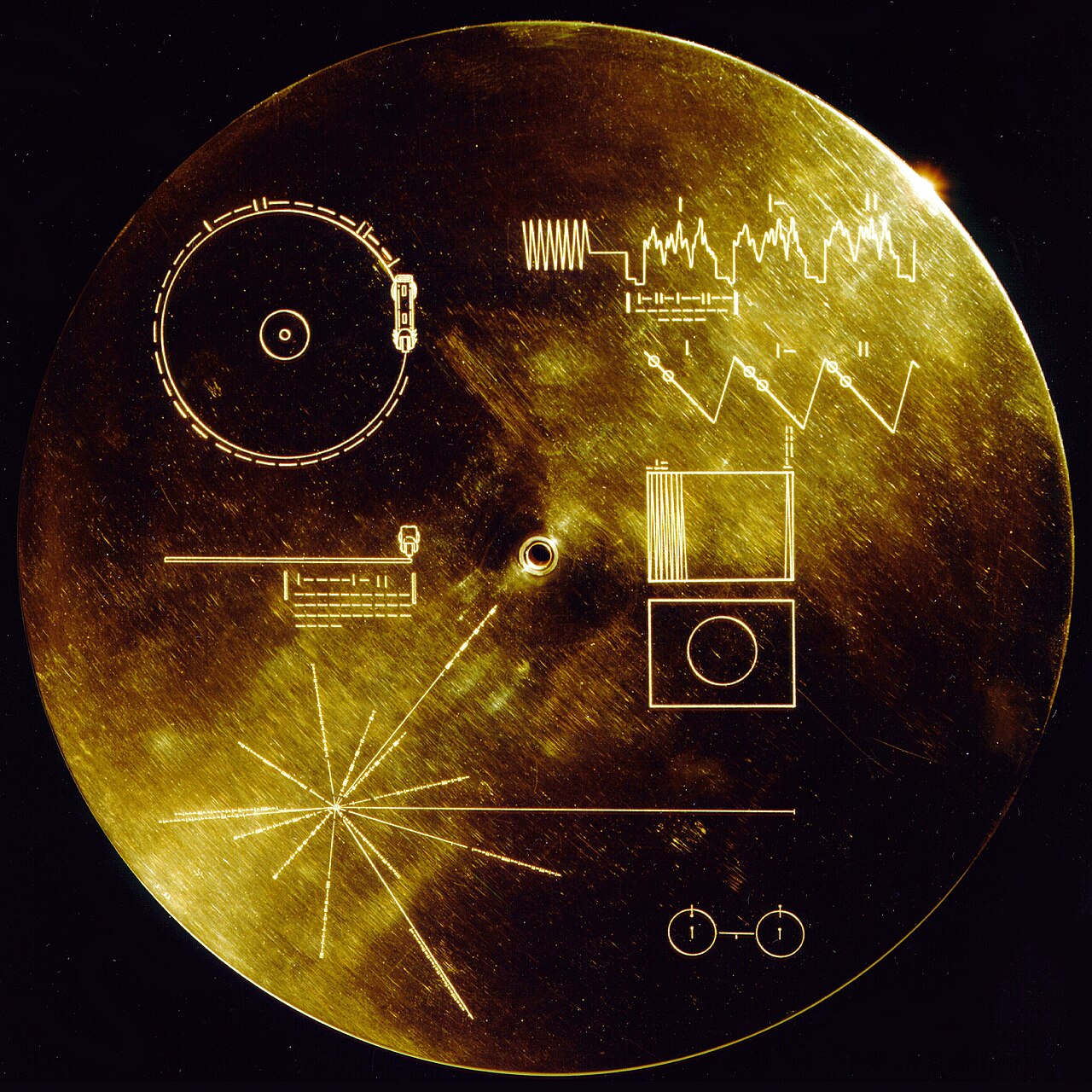
The Voyager Golden Record is a 12-inch gold-plated copper disc carried by both Voyager spacecraft, launched in 1977. It holds 116 images, natural sounds, 90 minutes of music and spoken greetings in 55 languages, chosen by a committee led by astronomer Carl Sagan as a message to anyone who might find it.
Why did NASA send a record?
Voyager 1 and Voyager 2 were built to fly past Jupiter and Saturn, and Voyager 2 went on to Uranus and Neptune. Both would then leave the solar system for good. NASA decided they should carry a message, as the earlier Pioneer probes had carried small engraved plaques. Sagan's committee, which included writer Ann Druyan as creative director, had to decide what to say about humanity in a single disc.
What is on the Golden Record?
- 116 images: encoded as sound, they include diagrams of mathematics, chemistry and human anatomy, and photographs of landscapes, animals, food, buildings and people from many cultures. The first image is a circle used to check that the pictures have been decoded correctly.
- Sounds of Earth: wind, thunder, surf, birdsong, whales, footsteps, a heartbeat, laughter and a kiss.
- Music: 90 minutes, from Bach, Beethoven and Mozart to Javanese gamelan, Peruvian panpipes, Navajo chants, Louis Armstrong and Chuck Berry's "Johnny B. Goode".
- Greetings: short hellos in 55 languages, ancient and modern, plus a spoken message from UN Secretary-General Kurt Waldheim and a written statement from US President Jimmy Carter.
The cover is etched with instructions for playing the record and a map showing the position of the Sun relative to 14 pulsars, so that a finder could work out where it came from. A stylus was packed alongside.
Where is Voyager 1 now?
Voyager 1 is the most distant human-made object. It crossed into interstellar space in August 2012, and NASA calculated that it would reach one light-day from Earth, about 25.9 billion kilometres, around 18 November 2026. A radio signal now takes about a day to reach it.
Its nuclear power source is fading, so engineers have been switching off instruments to keep it running. By April 2026, only two of its science instruments were still on. In tens of thousands of years it will drift past other stars, and the record is expected to last far longer than our own civilisation.
Will anyone ever hear it?
Almost certainly not. Sagan noted that the record would only ever be played if advanced spacefaring civilisations exist out there. But he argued that sending this "bottle" into the cosmic ocean said something hopeful about life on Earth, and for many people its real audience has always been us.




Leave a reply