'Oumuamua was the first object ever seen passing through our solar system from another star. It was spotted in October 2017. Its odd shape and unexpected speeding-up led to talk of alien technology, but most scientists think it was a natural icy body. Two more interstellar visitors, both clearly comets, have been found since.
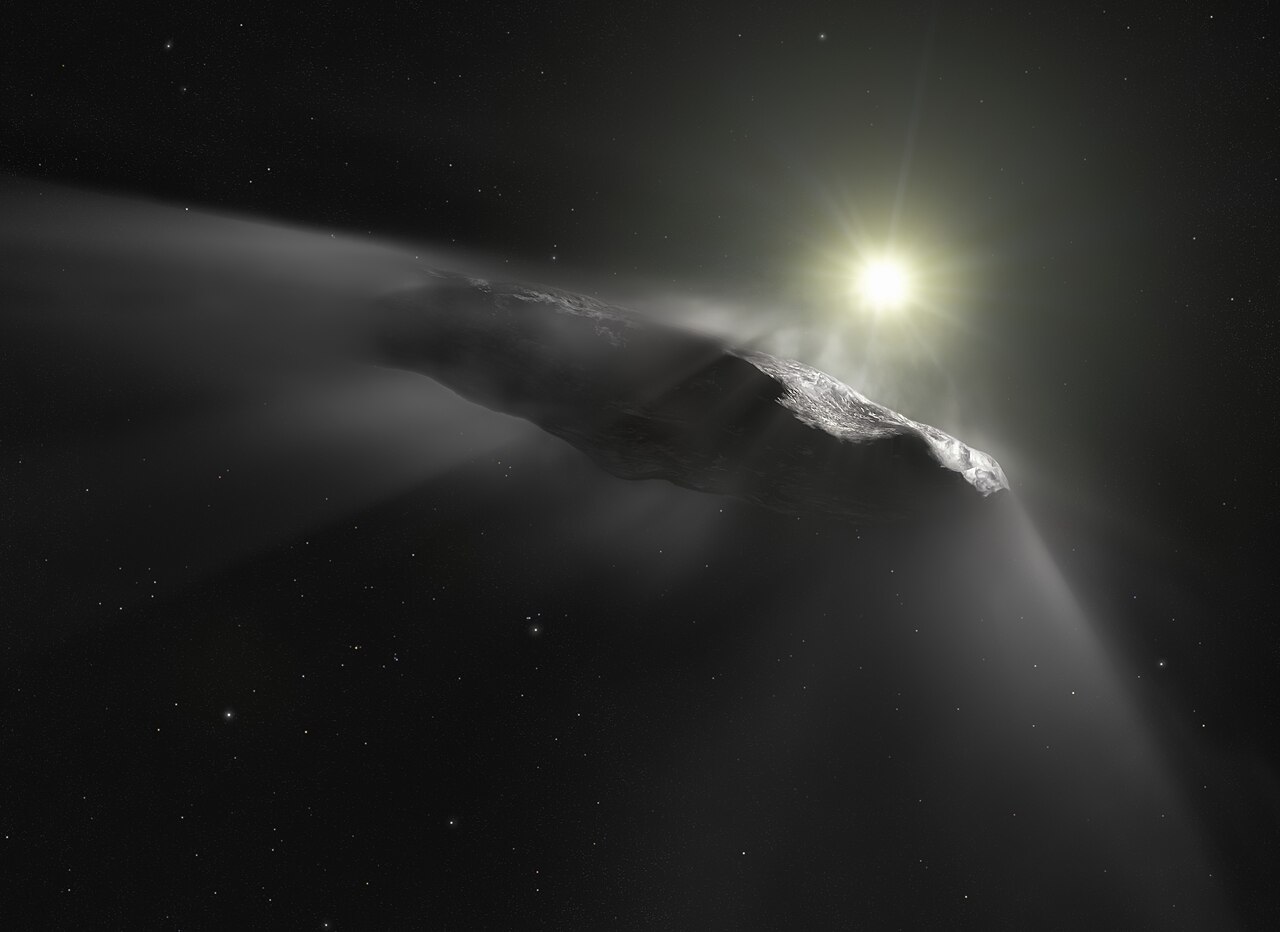
A visitor from another star
On 19 October 2017, astronomer Robert Weryk spotted a faint, fast-moving object in images from the Pan-STARRS telescope in Hawaii. Its path showed it was moving far too fast to be held by the Sun's gravity: it had come from interstellar space and was leaving again. It was named 'Oumuamua, a Hawaiian word for a scout or messenger.
Its brightness changed dramatically as it tumbled, suggesting an extremely elongated or flattened shape, perhaps a few hundred metres long. Unlike a comet, it showed no visible tail or cloud of gas and dust.
Why did some people think it was alien?
In 2018, astronomers reported that 'Oumuamua had sped up slightly as it left, more than the Sun's gravity alone could explain. Comets do that when gas escapes from them, but no gas had been seen. Harvard astronomer Avi Loeb suggested it might be a thin artificial "light sail" pushed by sunlight. The Breakthrough Listen project pointed a giant radio telescope at it in December 2017 and heard no signals.
What do scientists think it was?
Most think it was natural. In 2023, Jennifer Bergner and Darryl Seligman proposed in Nature that 'Oumuamua was a small, icy body whose ice had been altered by cosmic rays during its long journey, trapping hydrogen gas. As the Sun warmed it, that hydrogen escaped, too faint to see but enough to give it a push. Not everyone accepts the idea, but it explains the acceleration without aliens. Other proposals include a fragment of nitrogen ice.
The visitors that followed
- 2I/Borisov (2019): found by amateur astronomer Gennadiy Borisov in Crimea, it looked like an ordinary comet, with a clear tail.
- 3I/ATLAS (2025): discovered on 1 July 2025 by the ATLAS survey telescope in Chile, it was the third known interstellar object. Spacecraft around Mars and elsewhere observed it, and it gave off water and an unusual amount of carbon dioxide. Some studies suggest it may be older than our solar system. NASA said it was a natural comet.
New telescopes, especially the Vera C. Rubin Observatory in Chile, are expected to find many more. 'Oumuamua was the first of a new kind of object, and it is unlikely to be the last.










Leave a reply